The U.S. bicycle industry is entering a new phase of trade uncertainty as several major tariff developments unfold at the same time. While some recent decisions have brought short-term relief to importers, brands, and suppliers, the broader direction of U.S. trade policy suggests that tariffs will remain a central issue for the global bicycle business in 2026.
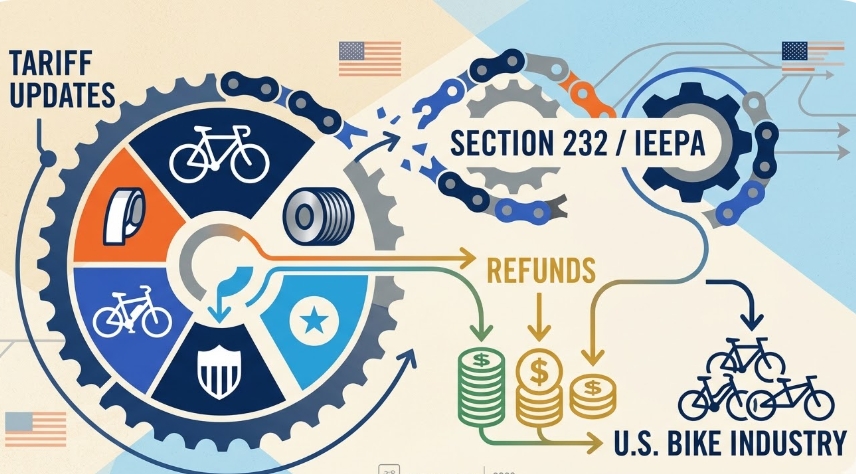
One of the most significant changes came after the U.S. Supreme Court ruled on February 20 that the administration had unlawfully used the International Emergency Economic Powers Act, or IEEPA, to impose sweeping tariffs on imports from nearly all major U.S. trading partners. The ruling removed a key legal basis for those emergency tariffs and opened the door for importers to pursue refunds on duties already paid. U.S. Customs and Border Protection has since announced that it will begin accepting IEEPA refund requests through a new automated CAPE process within ACE starting April 20, 2026. Under Phase 1, eligible claims include certain unliquidated entries and entries liquidated within the previous 80 days, specifically those liquidated on or after January 30, 2026. Valid claims are generally expected to be processed within 60 to 90 days.
Even so, the refund process is far from a complete solution. PeopleForBikes has warned that the CAPE system does not change legal deadlines or replace the need for protests and possible litigation. Phase 1 also excludes a number of categories, including drawback claims, flagged entries, entries under active protest, non-ACE entries, and entries subject to antidumping or countervailing duties. In practical terms, many companies are unlikely to recover all IEEPA-related duties through this first stage alone.
At the same time, the bicycle industry has secured an important win on Section 232. In early April, the U.S. government confirmed that bicycles, e-bikes, and frames will not be added as derivative products subject to the new steel and aluminum tariffs. That means importers will not have to calculate the metal content of those products or pay additional duties based on that content. The decision also removed existing steel tariffs on e-bikes. According to PeopleForBikes, the industry submitted more than 1,300 comments opposing the proposal, more than any other industry, helping prevent what could have become a major new cost and compliance burden. The changes took effect on April 6, 2026.
However, this relief does not mean the tariff era is ending. In March, the Office of the U.S. Trade Representative launched a new Section 301 investigation focused on industrial overcapacity and government subsidies in a wide range of manufacturing economies, including China, the European Union, Japan, Taiwan, Cambodia, Vietnam, Malaysia, India, Indonesia, South Korea, and Mexico. The notice does not yet identify specific product categories or tariff rates, but it clearly signals that Washington is preparing new legal pathways for future trade action after the setback to its earlier IEEPA tariff program.
For the bicycle industry, the implications are significant. Many of the countries named in the Section 301 investigation are central to global bicycle and e-bike production. Any future tariffs could affect sourcing strategies, landed costs, supply-chain planning, and pricing decisions across the industry. Public comments are open through April 15, with a live hearing scheduled for May 5. Any resulting measures are not expected before May and could come later, after further review.
Taken together, these developments show that the U.S. is not stepping away from tariff-based trade policy. Instead, it is shifting from broad emergency measures toward more structured and potentially more durable trade tools. For global buyers, brands, and manufacturers, 2026 is shaping up not as a year of tariff resolution, but as a year of tariff transition. Some old burdens are easing, but new pressures are already building.