The New York City Council held a joint hearing on September 30 to review 23 legislative proposals aimed at improving the safety of e-bikes, e-scooters, and other micromobility devices.
The hearing was jointly convened by the Committee on Transportation and Infrastructure, the Committee on Consumer and Worker Protection, and the Committee on Public Safety. The proposals cover enforcement, delivery services, vehicle compliance, street infrastructure, and safety reporting.
Among the measures under review are proposals that would require third-party delivery services to obtain a city license, verify the registration of mopeds used by delivery workers, and meet liability insurance requirements.
Other proposals target device compliance, including an e-bike trade-in program, the use of dynamometers to test vehicle motor power and maximum assisted speed, and restrictions on the sale and rental of Class 3 e-bikes. One proposal would prohibit the sale and rental of Class 3 e-bikes, while another would prohibit their operation on city streets, in parks, and other public places.
Under New York State's e-bike classification system, Class 1 and Class 2 e-bikes may provide motor assistance up to 20 mph, while Class 3 e-bikes may provide motor assistance up to 25 mph. Separately, New York City imposes a 15 mph operating speed limit on e-bikes, e-scooters, and pedal-assist commercial bicycles. Devices with motors capable of exceeding 25 mph are not legal to sell or operate in New York City.
The proposals also address rider behavior and delivery operations. Measures under consideration include technology to detect sidewalk riding and automatically reduce vehicle speeds on shared micromobility systems. Another proposal would require delivery platforms to track specified unsafe riding behaviors, including wrong-way riding and sidewalk riding.
For street infrastructure, one proposal would require the New York City Department of Transportation (DOT) to install traffic-calming measures at no fewer than 50 intersections with bicycle lanes and study their impact on crashes and injuries.
Another proposal would require the city's bike-share operator to report safety incidents involving its bicycles and e-bikes, including collisions, traffic violations, theft, and vandalism, with the Department of Transportation required to publish the information every six months.
According to City Council data, the first six months of 2026 recorded 738 injuries and 13 fatalities among e-bike riders, compared with 601 injuries and 10 fatalities during the same period in 2025. The Council estimates that approximately 65,000 delivery workers use e-bikes or other micromobility devices to make deliveries across New York City, accounting for roughly 40% of micromobility traffic.
New York City's 15 mph operating speed limit is separate from New York State's e-bike classification system. NYC DOT states that Class 1, Class 2, and Class 3 e-bikes may provide motor assistance up to 20 mph, 20 mph, and 25 mph, respectively, but all three classes are subject to the city's 15 mph operating speed limit.
The 23 measures were proposals under consideration at the September 30 hearing and would need to proceed through the City Council's legislative process before becoming local law.
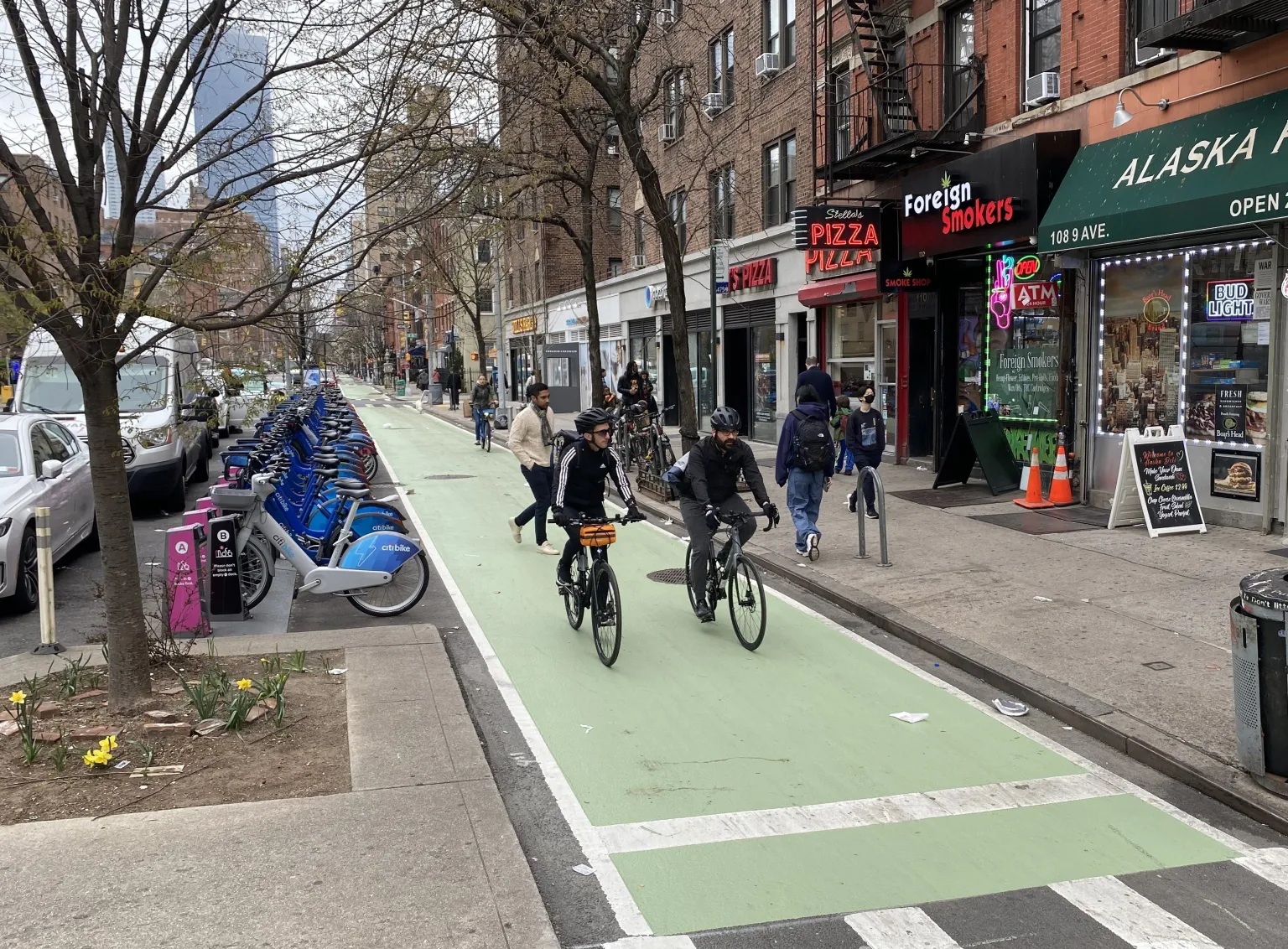 Photo: NYC DOT