Portuguese environmental organisation Quercus has called for the creation of a National Public Bicycle Systems Plan to expand bike-sharing services across Portugal and strengthen the role of cycling in urban mobility.
The proposal was presented on 22 September, European Car Free Day. Quercus said existing public bike-sharing systems in Portugal are generally small. Data from the Collaborative Network for Active Mobility shows that half of the country's existing systems have four or fewer stations and 15 or fewer bicycles. Quercus said the limited scale makes it difficult for bike sharing to become part of daily mobility, while coverage is often concentrated in central areas, leaving peripheral neighbourhoods and neighbouring municipalities underserved.
The proposed national plan would establish coverage targets, minimum size and quality criteria for public bike-sharing systems, as well as stable multi-year funding. Quercus also called for a national network of safe and continuous cycle routes connecting bike-sharing systems with schools, railway stations, bus terminals and employment areas.
For greater integration between systems, Quercus proposed mandatory interoperability between bike-sharing schemes operated by different municipalities and operators, including a regional single app and fare structure. It also called for combined passes covering bike sharing and public transport, positioning shared bikes as a last-mile option within intermodal journeys.
Other proposals include reducing VAT on bicycle purchases, repairs and rentals, as well as bicycle safety equipment; introducing cycling and road-safety education in schools; and providing tax incentives for companies that compensate employees for bicycle commuting or provide bicycle fleets for work-related travel. Quercus also called for stronger workers' compensation insurance coverage for bicycle commuting.
Quercus also highlighted the Portuguese government's recent allocation of €2.02 million to 56 municipalities through the Environmental Fund for the preparation of Sustainable Urban Mobility Plans. The organisation said these plans should be accompanied by concrete investment in infrastructure and incentives for active mobility.
Quercus cited research by EIT Urban Mobility and Cycling Industries Europe estimating that bike sharing generates around €305 million in annual social and economic benefits across Europe, while avoiding approximately 46,000 tonnes of CO₂ emissions and 200 tonnes of air pollutants. The study also estimates that bike sharing helps save around 760,000 hours of productivity through reduced traffic congestion, valued at €30 million, and supports around 6,000 full-time jobs across Europe.
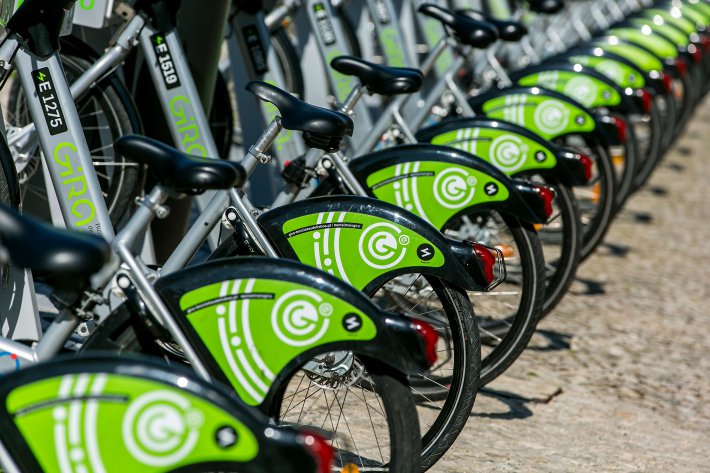
Photo: EMEL / GIRA – Bicicletas de Lisboa