PeopleForBikes has released its 2026 International City Ratings, evaluating 403 cities across 38 countries based on how well their bicycle networks connect residents to everyday destinations. Dutch cities topped both the large- and medium-city categories.
The ratings use Bicycle Network Analysis (BNA) to assign each city a score from 0 to 100, measuring how well its bicycle network connects people to jobs, schools, healthcare, shopping, recreation and other everyday destinations. According to PeopleForBikes, cities scoring 50 or higher typically have connected, low-stress cycling infrastructure, including slow neighborhood streets, off-street bike paths and protected bike lanes.
In the large-city category, defined as populations above 300,000, Utrecht and Amsterdam in the Netherlands tied for first with scores of 88. Hannover, Germany, followed with 87, while The Hague scored 85. Rotterdam, Antwerp, Munich and Valencia each received 84.
In the medium-city category, covering populations of 50,000 to 300,000, Dutch cities Almere and Delft tied for first with scores of 88. Leuven in Belgium, along with Rijswijk and Zoetermeer in the Netherlands, scored 85. Canmore, Alberta, Canada, led the small-city category, covering populations below 50,000, with a score of 87.
The 2026 international ratings added 42 cities, including cities in 12 countries participating in the program for the first time: Austria, Czechia, Denmark, Hungary, Lithuania, Malaysia, Norway, Peru, Poland, Romania, Switzerland and Vietnam. Combined with the 3,019 U.S. cities rated earlier this year, the program covers 3,422 cities worldwide.
In a separate comparison published on November 9, PeopleForBikes examined how U.S. cities compare with European cities. Small U.S. cities generally scored higher than their European counterparts, while the gap was more pronounced among large cities. Minneapolis scored 68, compared with 88 for Utrecht, a 20-point difference.
PeopleForBikes cautioned that international and U.S. city ratings should not be treated as direct, one-to-one comparisons because of differences in population and employment data.
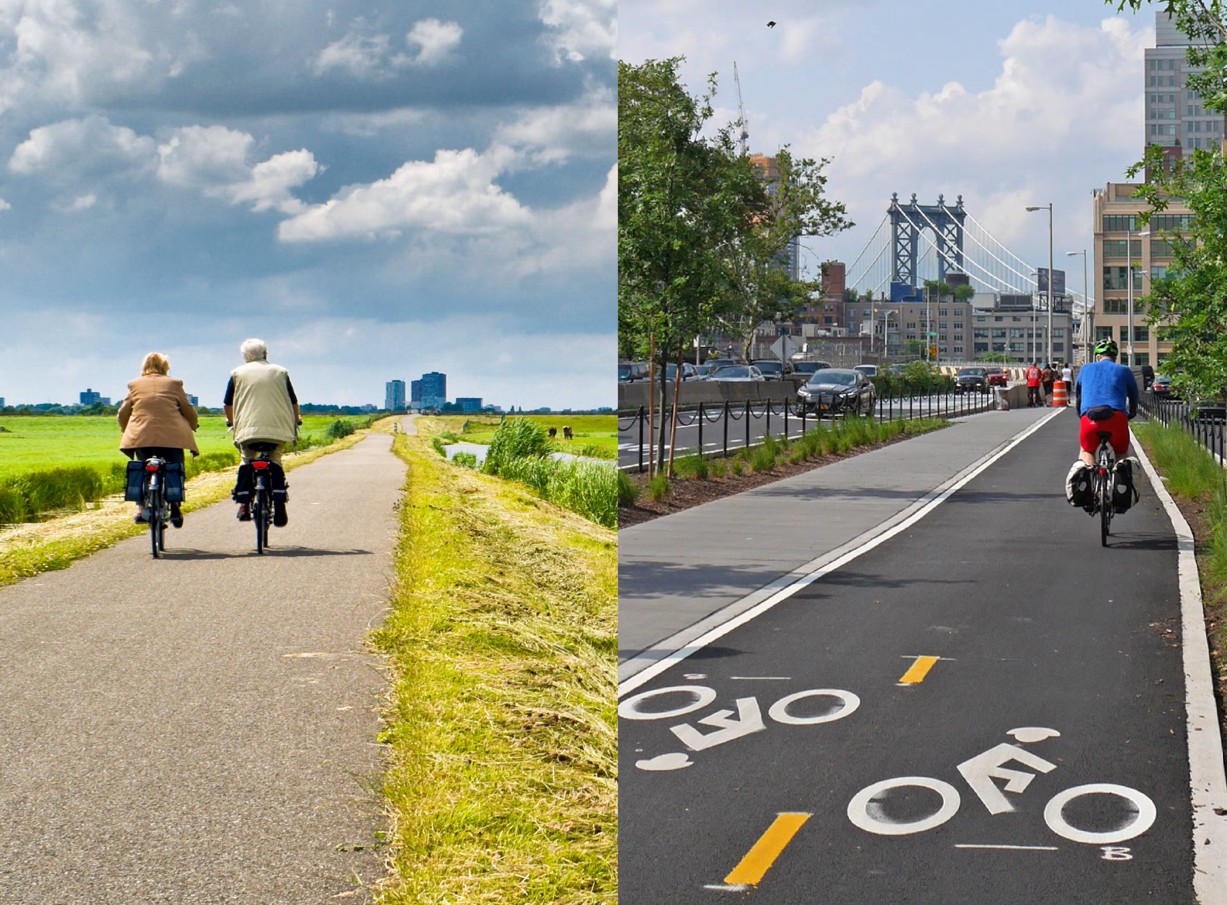 Photo: PeopleForBikes