German testing institute Velotech is advocating a more comprehensive approach to battery safety, calling for batteries to be tested not only as individual components but also when installed in complete pedelecs under dynamic operating conditions.
Based in Schweinfurt, Germany, Velotech conducts dynamic tests on pedelecs, e-scooters and electric wheelchairs. Its testing programmes simulate mechanical stresses, including impacts and vibrations, while the battery simultaneously powers the vehicle. The aim is to replicate stresses over a defined service life and identify changes in the battery system.
The issue has gained attention following a recall in France. On November 9, 2026, the official RappelConso platform announced the recall of the EVERCROSS EK28 electric bicycle, sold through retailer NOZ between September 21 and October 14, 2026. The battery did not meet European requirements and posed a fire risk. Consumers were instructed to stop using the bicycle and return it for a refund. The specific technical cause was not disclosed.
Velotech acknowledged that, without published test findings, it is impossible to determine which testing procedure would have detected the problem.
The proposed approach examines the interaction between the battery, housing, mounting system, locking mechanism, cables and electrical contacts, as well as system performance under load. Repeated mechanical stress can reveal loosening, abrasion and contact problems. Testing conditions are determined by vehicle type, intended use, loading and an agreed stress profile, while the simulated mileage or service life must be technically justified.
Regarding standards, EN 50604-1 establishes safety requirements and test methods for lithium battery packs and systems used in light electric vehicles. Meanwhile, the international standard IEC 63623-1 is still under development, with its final requirements yet to be established.
Velotech believes that existing safety assessments of battery cells and packs should be complemented by dynamic testing of complete vehicles while the battery is powering the drive system. These tests are intended to supplement, rather than replace, existing electrical and thermal battery testing procedures.
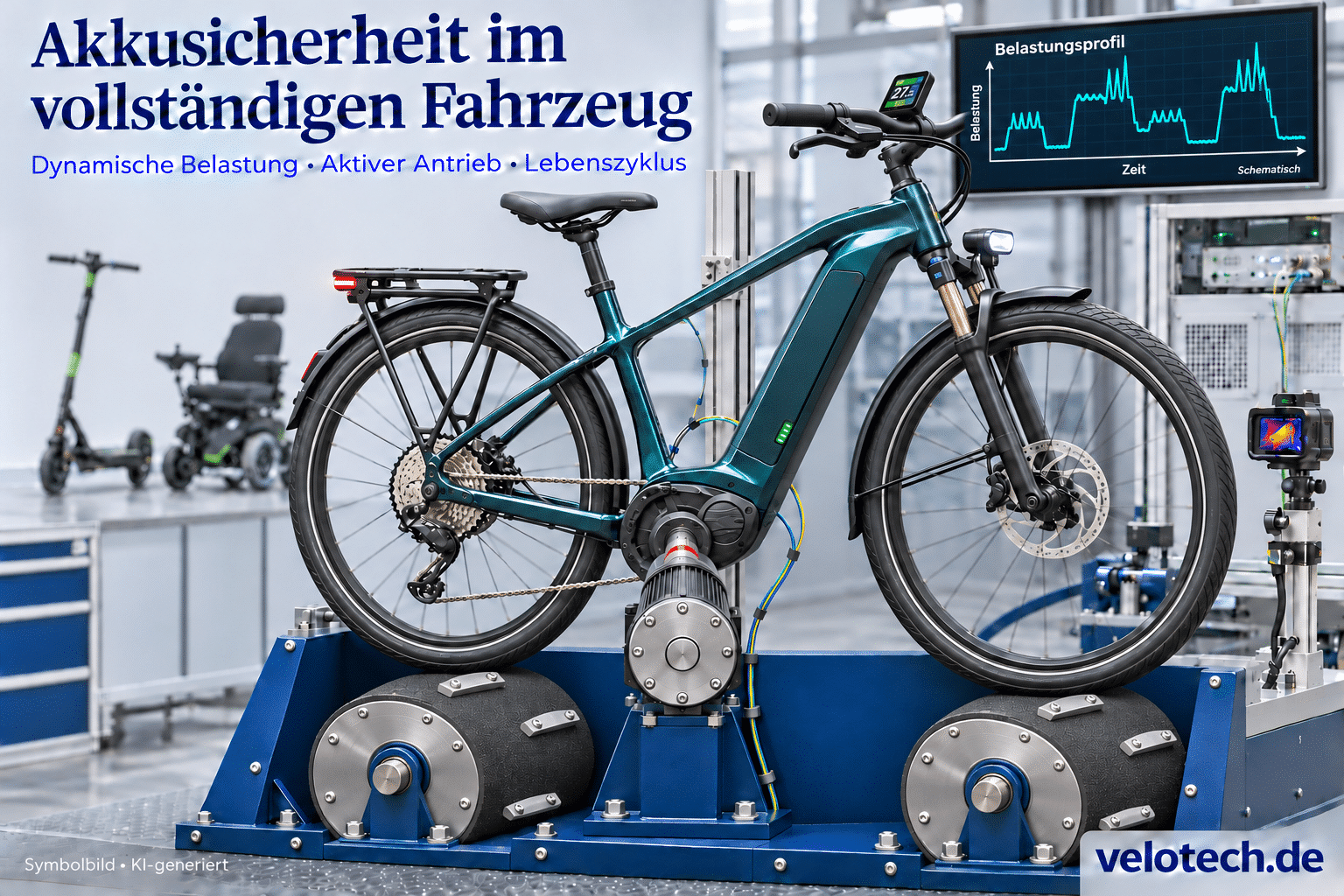 Photo: Velotech