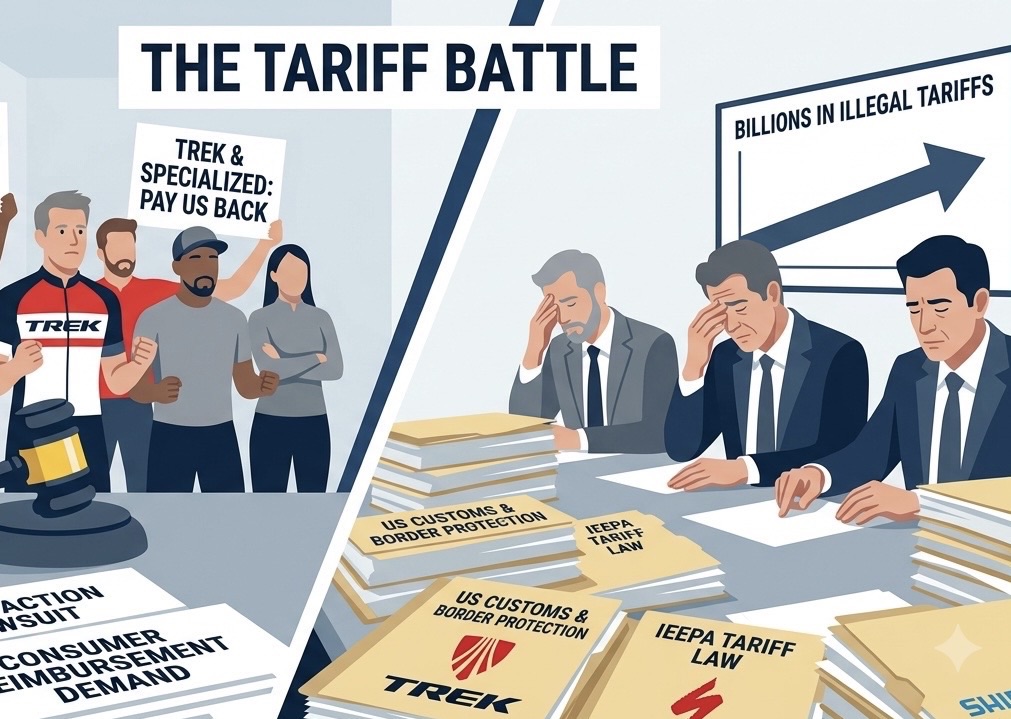
The U.S. bicycle industry is reeling from a massive legal storm. The high-stakes tariff battle led by industry heavyweights—including Trek, Specialized, Marin, Shimano, and Ibis—against U.S. Customs and Border Protection (CBP) reached a major turning point following a landmark Supreme Court ruling. The Court deemed the emergency tariffs imposed under the International Emergency Economic Powers Act (IEEPA) an unlawful overreach of executive power.
However, what was initially celebrated as a corporate victory against the government has devolved into a complex three-way legal battle involving manufacturers, the federal government, and angry consumers. Here is the latest update on the situation:
1. Illegal Tariffs Halted; Brands Chase Millions in Refunds
Following the Supreme Court's 6-3 decision, CBP officially halted the collection of the disputed IEEPA duties.
* CAPE Refund Mechanism Launched: U.S. Customs has since deployed a new "CAPE retroactive recovery system" on the ACE platform, allowing eligible importers to claw back their share of the estimated $170 billion in unlawfully collected tariffs.
* Massive Payouts Under Negotiation: According to updates from the Court of International Trade (CIT), due to the sheer volume of companies seeking refunds plus interest, new filings have been temporarily paused to process existing plaintiffs. Brands like Ibis and Marin confirmed that the illegal tariffs had eroded nearly $1 million to $2.2 million in profits per brand, which they are now aggressively pursuing.
2. Backfire: Trek and Specialized Hit with Consumer Class-Actions
The anticipation of massive government refunds has triggered fierce backlash from the public. A consumer class-action lawsuit was filed against Specialized and Trek in the U.S. District Court for the Northern District of California.
* Accusations of "Double-Dipping": Plaintiffs allege that Trek and Specialized immediately passed the tariff burdens onto consumers when the duties were implemented, tacking on "tariff surcharges" ranging from $25 to as high as $1,400 per bike depending on the model.
* Demands to Relinquish Surcharges: The lawsuit argues that since the Supreme Court ruled the tariffs illegal and the brands are recovering those funds from the government, keeping the consumer surcharges constitutes unjust enrichment. The class-action is seeking over $5 million in damages.
3. Supply Chain Limbo: New Section 301 Tariffs Looming
Despite striking down the IEEPA tariffs, the bicycle industry has little time to celebrate. The Office of the U.S. Trade Representative (USTR) announced plans to introduce new "Section 301 Forced Labor Investigation Tariffs" to plug global supply chain loopholes. The upcoming policy is expected to slap a 10% to 12.5% tariff on more than 60 countries, targeting major traditional bicycle sourcing hubs.
This legal feud underscores the extreme vulnerability of the bicycle supply chain to geopolitical volatility. While top-tier brands successfully defended their margins against the government, they now face a severe trust and legal crisis with their own consumer base. Balancing refund distribution with market pricing while preparing for the upcoming Section 301 duties will be the ultimate test for bicycle executives in the coming months.