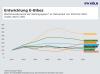
Germany’s bicycle market continued to face a period of consolidation in 2025, with consumer-level market volume falling 5.1% year on year to €9.4 billion, according to the 2026 Branchenbericht Fahrräder published by IFH KÖLN and BBE Handelsberatung.
The decline marks the third consecutive year of falling market volume. However, the market remains significantly above its pre-pandemic level following the exceptional growth recorded during the COVID-19 period.
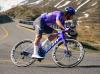
While the overall market contracted, several product categories continued to perform positively. Road sport bicycles, including gravel bikes, increased their market share, while e-gravel bikes emerged as one of the stronger growth segments within the otherwise declining e-bike market. Electric all-terrain bikes also recorded positive development.
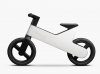
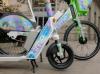
Children’s and youth bicycles likewise benefited from increased demand. According to the study authors, the segment is currently supported in part by the higher birth rates recorded during the pandemic period.
“Gravel bikes have sustainably transformed the road sport bicycle segment and created significantly more momentum,” said Christoph Lamsfuß, Senior Project Manager at IFH KÖLN. He noted that gravel bikes combine sporting performance with everyday practicality, appealing to a broader audience than traditional road bikes.
A similar potential is seen in e-gravel bikes, which can be used for touring, leisure and everyday mobility, creating additional opportunities for market growth.
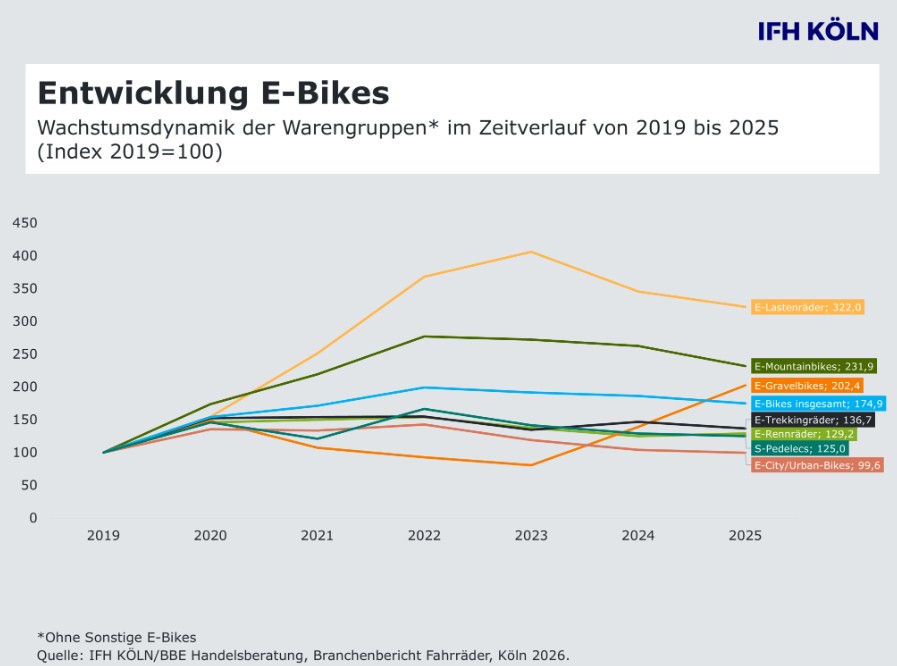
Photo: IFH Köln | BBE Handelsberatung
Larger Bicycle Retailers Gain Ground
The market consolidation is also affecting retail structures. Bicycle specialist retailers remain by far the most important sales channel in Germany, but larger specialist stores and retail chains are continuing to gain market share.
According to IFH KÖLN and BBE Handelsberatung, larger retailers benefit from broad product ranges and larger sales and display areas, particularly for e-bikes and cargo bikes.
Smaller and medium-sized retailers, meanwhile, are increasingly focusing on workshop, service and repair operations to strengthen their market position and develop additional sources of revenue beyond new-bike sales.
Despite the pressure on the market, the number of market participants has remained relatively stable. According to the study, only 124 bicycle retailers have exited the German market since 2016.
Florian Schöps, Manager of Business Consulting at BBE Handelsberatung, said the third consecutive decline shows that the bicycle market is undergoing consolidation. He added that companies with optimized processes, clear strategic positioning and strong control of their business performance can use the current market phase to strengthen their positions.
The Branchenbericht Fahrräder 2026 analyzes Germany’s bicycle market volume, individual product segments and distribution structures from 2016 to 2025, and also provides a market forecast through 2030.

Photo: IFH Köln