Queensland introduced new rules for e-bikes, e-scooters, e-skateboards, e-unicycles and other personal mobility devices (PMDs) on July 1, 2026, with additional age and licensing requirements taking effect on August 31, 2026.
Under the new rules, a legal e-bike must have an electric motor with a maximum continuous output of 250 watts. It must be pedal-assisted, with the pedals as the primary source of power, and the motor must stop providing assistance at 25 km/h. Riders can continue travelling faster through human pedalling. Throttle control is permitted only up to 6 km/h to help the rider start moving.
E-scooters, e-skateboards and e-unicycles are also subject to a maximum motor-assisted speed of 25 km/h. A transition period applies until February 28, 2027, giving owners time to ensure their devices comply with the speed requirements. From February 28, 2027, devices that can exceed 25 km/h through motor power will be considered non-compliant. The Queensland Government advises owners to contact their retailer or manufacturer about options for limiting or locking the maximum speed.
Speed Limits and Where PMDs Can Be Used
On footpaths, a maximum speed of 12 km/h applies at all times to protect pedestrians. On shared paths, riders must slow to 12 km/h when passing pedestrians. Otherwise, riders must follow the signed speed limit for the path.
On roads with a speed limit of 60 km/h or less, PMDs can be ridden on the road or in bike lanes, subject to applicable road rules and the 25 km/h maximum speed limit. PMDs cannot be ridden on motorways or where bicycle-prohibited signs apply.
Age and Licence Requirements From August 31
From August 31, 2026, riders must generally be at least 16 years old and hold a valid driver licence. A Queensland, interstate or overseas learner licence is accepted as the minimum licence requirement.
There are specific exemptions. Children aged 12 to 17, including 16- and 17-year-olds who do not hold a learner licence, can ride under the supervision of a parent or caregiver. The supervisor must remain close enough to provide instructions.
People aged 16 or older who cannot obtain a driver licence because of a disability or medical condition may also be eligible for an exemption.
Children and unlicensed riders can use e-mobility devices without meeting the age and licensing requirements in certain designated recreational areas, including rail trails, mountain bike trails and private off-road recreational cycling facilities.
Device Requirements
E-scooters, e-skateboards and e-unicycles must comply with maximum dimensions of 1,350 mm in height and 750 mm in width. For devices with two or more wheels, the maximum wheelbase is 1,100 mm.
Devices must have working brakes. When ridden at night or in hazardous conditions, they must have visible and working front and rear lights. Devices fitted with handlebars must also have a bell.
E-bikes have separate compliance requirements. Legal e-bikes must meet the applicable requirements, including the 250-watt motor limit, 25 km/h motor-assistance cut-off and pedal-assist requirements. E-bikes must also display an EN 15194 compliance label, with a transition period for the labelling requirement until February 28, 2027.
Riding and Safety Requirements
Riders must wear an approved helmet that is properly fastened under the chin.
Riders must have a blood alcohol concentration below 0.05. Queensland Police will conduct random breath tests.
Holding a mobile phone or having it resting on any part of the body while riding is prohibited. This rule applies even when stopped at traffic lights or when the phone is turned off or not in use. A phone mounted in a cradle on the handlebars is permitted.
Riders must give way to pedestrians on paths, use their bell to warn pedestrians when approaching and slow down when passing. Careless riding, including dangerously weaving through pedestrians or travelling at unsafe speeds around blind corners, is prohibited.
Passengers are generally prohibited on PMDs. For e-bikes, passengers may only be carried when the bicycle is specifically designed to carry them.
If a crash occurs, riders must stop, remain at the scene and provide assistance to anyone injured. They must also exchange contact details with people involved in the crash, injured people or the owner of damaged property, as required.
Police Powers and Enforcement
From July 1, 2026, Queensland Police have additional powers to seize and destroy clearly illegal devices used in public places. The reforms also introduce or increase penalties for a range of offences involving e-mobility devices.
The Queensland Government says the new rules are intended to improve safety and clarify requirements for e-bikes, e-scooters and other e-mobility devices.
According to Queensland Government data, eight people lost their lives in e-scooter crashes in 2025. From 2022 to 2025, 6,089 people presented to emergency departments at 36 participating Queensland hospitals following e-scooter crashes. The government notes that these figures do not cover all hospitals in Queensland.
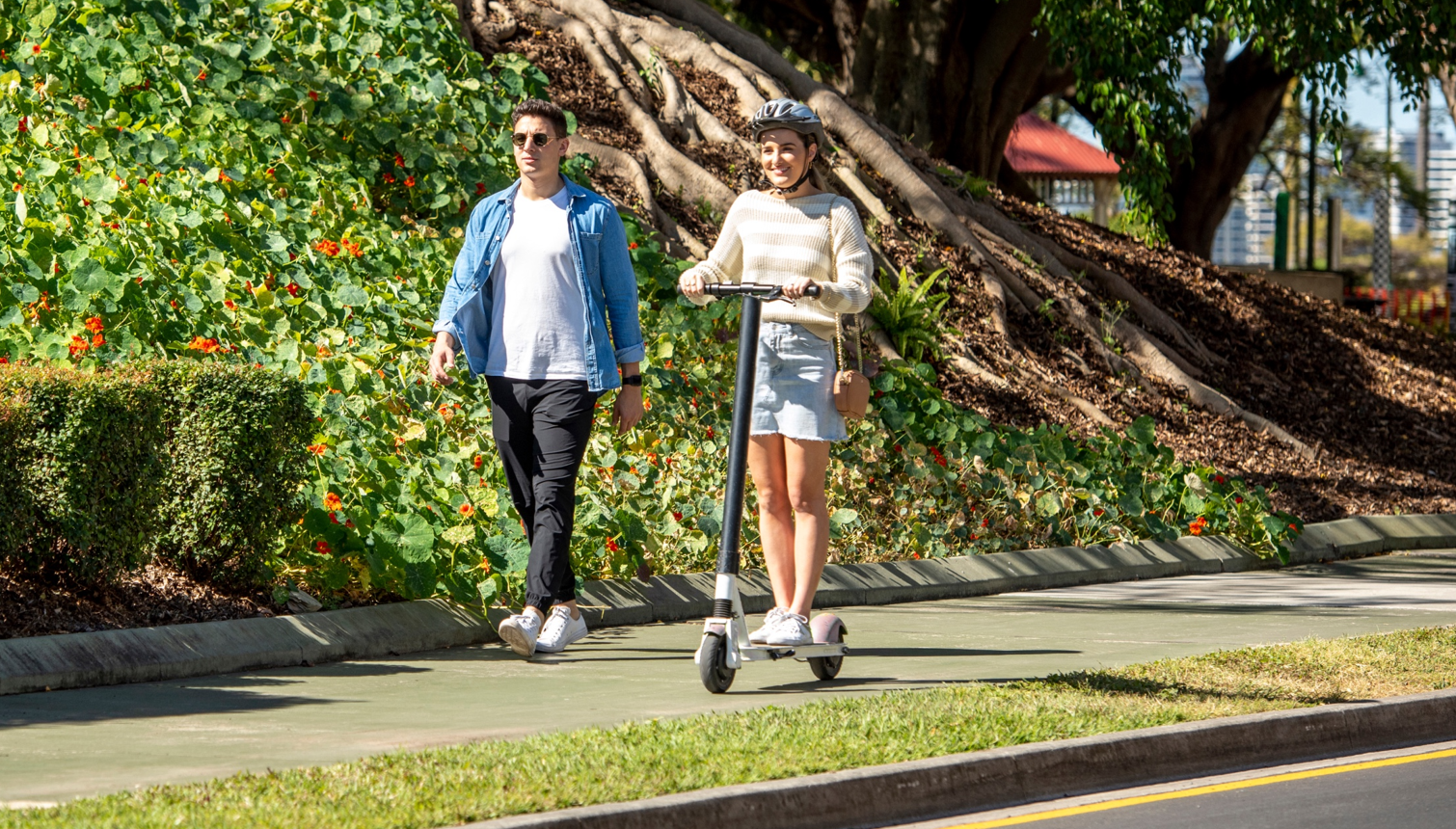 Photo: The State of Queensland