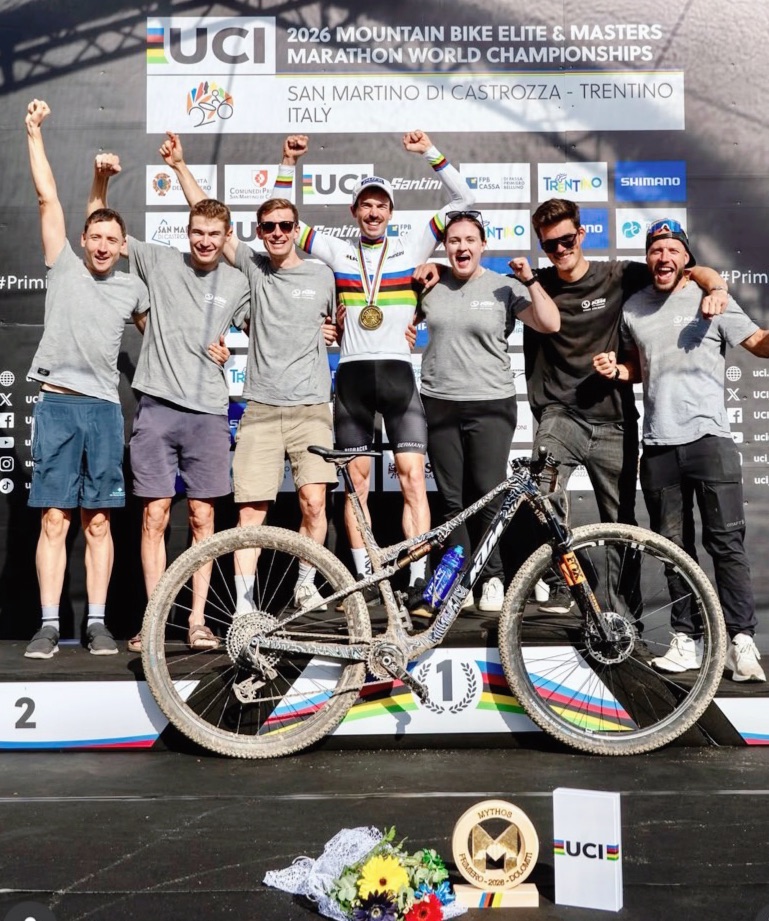
The 32-inch mountain bike has moved from an experimental concept to a proven race-winning platform. German rider Andreas Seewald made history at the 2026 UCI Mountain Bike Marathon World Championships (XCM), winning the Elite Men’s title aboard the KTM Scarp Evo 4 32 Prototype.
Seewald, who races professionally for SINGER KTM RACING, conquered the roughly 95 km course with around 4,000 meters of climbing. His victory marks the first XCM World Championship title won on a 32-inch mountain bike, providing significant real-world validation for the emerging wheel standard.
A Complete 32-Inch Race Platform
The KTM Scarp Evo 4 32 Prototype is a carbon full-suspension race bike developed specifically around 32-inch wheels. Its race setup includes a FOX RAD Prototype 32” fork, FOX Float Factory rear shock, DUKE Lucky Jack SLS5 32” wheels, Schwalbe Race Pro 32” tires, SRAM XX SL Eagle Transmission, and Shimano XTR M9200 brakes.
The larger wheel diameter potentially offers improved rollover capability, momentum retention and high-speed stability—advantages that could be particularly valuable in marathon racing over long distances and rough terrain.
However, 32-inch wheels also bring engineering challenges, including additional rotational inertia, frame geometry requirements, wheel stiffness and rider fit. Seewald’s victory does not prove that 32-inch wheels are inherently faster than 29-inch wheels, but it demonstrates that the platform is already capable of winning at the highest level of XCM competition.
KTM Chairman: 32-Inch Scarp Already in Production
More importantly for the bicycle industry, KTM’s 32-inch development is no longer limited to prototype testing.
KTM Chairman Carol Chen said the 32-inch full-suspension Scarp has already entered production.
This marks an important transition for KTM’s 32-inch program:
Concept → Prototype Testing → World Championship Victory → Production
The development of a supporting component ecosystem is also accelerating. FOX, DUKE and Schwalbe are already involved with 32-inch suspension, wheels and tires, suggesting that the new wheel size is moving beyond isolated experimentation toward a more complete MTB platform.
For bicycle manufacturers and suppliers, this could create new opportunities in frames, rims, hubs, spokes, tires, suspension and related components, particularly if 32-inch wheels gain traction in high-end XC and marathon racing.
Will 32 Inches Challenge 29 Inches?
It is still too early to suggest that 32-inch wheels will replace the established 29-inch standard. The 29er benefits from a mature global component ecosystem and proven geometry across a wide range of riders and applications.
Nevertheless, Seewald’s World Championship victory—combined with KTM’s confirmation that the 32-inch Scarp has entered production—changes the industry conversation.
The question is no longer simply whether a 32-inch MTB can work, but where and how quickly the new platform could establish itself alongside 29-inch bikes.